

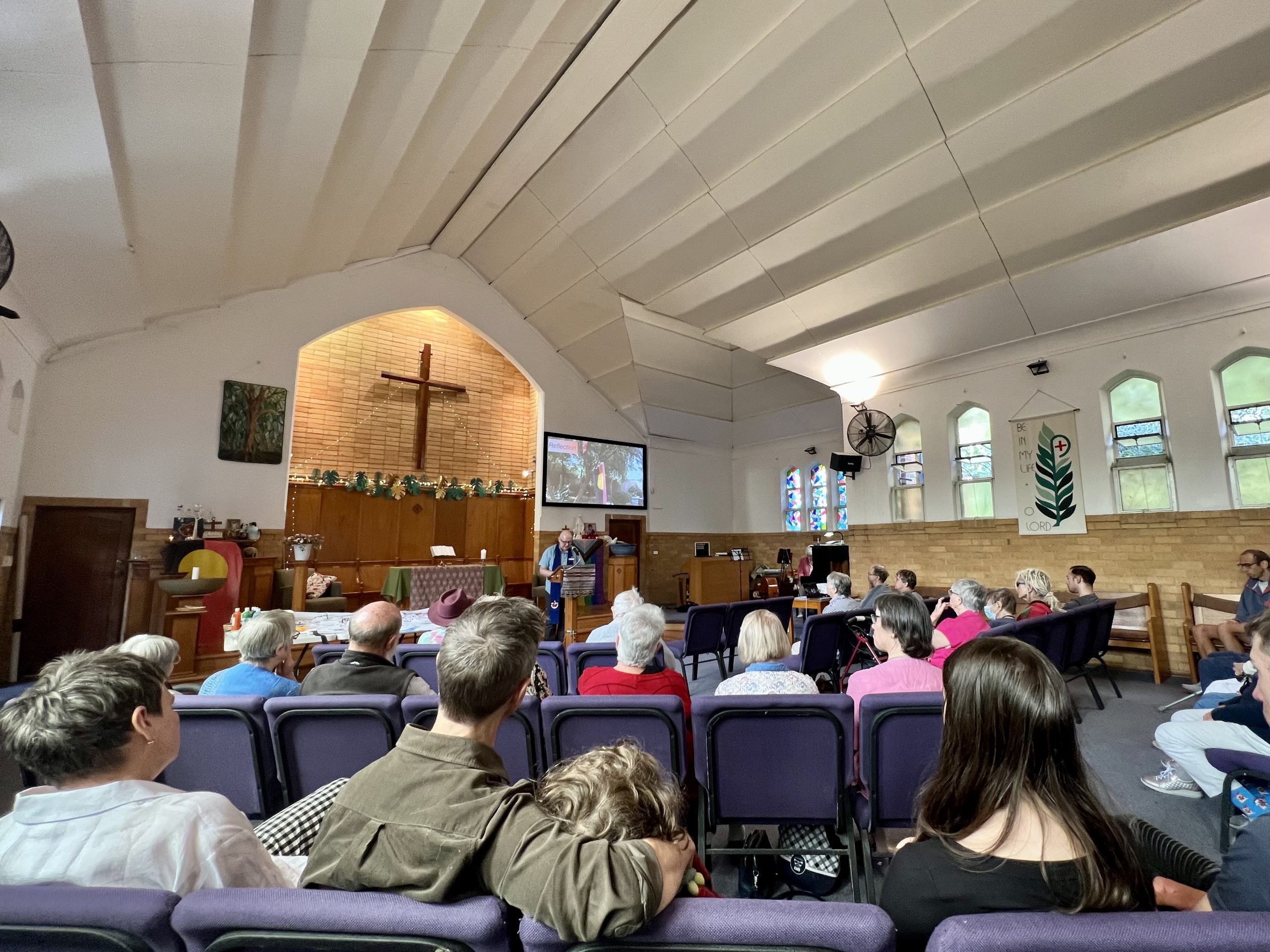
The crowd, with Compassion
When have you been part of the crowd? When was the last time you were in a crowd? Since the years of Covid, for some, crowds have taken on another meaning, or our relationship with being in crowds has changed.
As you know, a few weeks ago, I was lucky enough to go to the Split Enz concert and Rob Laver Area. It was a wonderful evening, shared with old friends. And I was part of different crowds: there was a crowd on the tram: it was kind of fun. There was joy and excitement, expectation and wonder. I liked that crowd. Then there was the crowd, a convergent crowd, coming from all directions towards an entrance, ready for bag inspection and body scanning: and I didn’t like that crowd; and I didn’t like the feel of convergence. I hated the crowd in the Rod Laver concourse, as people navigated which door they would enter: and the long and steep steps down to our seats. I felt hemmed in, a bit like lemmings, and unable to feel any sense of freedom. Being in the crowd however, in the audience, once we were seated. was just fine. I did have a few moments of deeply appreciating the ‘US’ created by the music. The anthems of a generation of pop music by gifted artists.
When have you been part of the crowd? When was the last time you were in a crowd? “When he saw the crowds, he had compassion for them, because they were harassed and helpless, like sheep without a shepherd.”
Crowds are curious things. They are both singular and plural: sometimes at the same time. Crowds are singular in a way that a single spirit animates them. As the crowd was on that tram. Theologians Michael Hardin and Jeff Krantz comment on the plurality of the crowds; Crowds, in their seeming same-ness can reveal proportionate rivalries. In a football analogy, for example, some gather for one team or the other team: some gather because their membership grants them access to the ground. Crowds can conceal both love and hate: violence and tolerance at the same time. Polar opposites can be drawn together by another purpose. And maybe every crowd conceals an un-conscious need for a scapegoat.
Do you think, when Jesus looked out at the crowds, he saw those textures in the crowd? Does our reading of the text allow for that?
When you’ve been in crowds, have you felt that sense of one-ness? Have you found compassion in being in or looking at the crowd you’re in?
The Greek Word for compassion in the New Testament, has meanings of when feelings resonate in out guts. As Kath and Kim would say, “I can feel it in my waters Kim.” The meanings of New Testament compassion flow of visceral responses to things: and that moves the meaning towards a compassion that has to do with mercy for one another.
This meaning is a specialised usage in the Synoptic Gospels, with that particular verb form found only there, and it is only used to either
- describe an emotion of Jesus, or
- used by Jesus, in a parable, to describe the response of compassion by a major character therein.
If we are crowd that Jesus looks out upon: do you feel his compassion? Might you imagine that for a moment?
And what is it to hear the proclamation of the Gospel to you this morning… ‘ ‘The kingdom of heaven has come near’ ’.
When we are also asked to do likewise, ‘to proclaim the good news, that ‘The kingdom of heaven has come near’.’ … Why is it, do you think, that we shy away from proclaiming the Gospel?
This has been on my mind, because a few Sunday ago I made a comment about the secrecy of our Sunday attendance in our other lives. “How was your weekend? What did you do?” And we tell our friends and family EVERYTHING we did on the weekend EXCEPT this precious, important thing we do together, Sunday by Sunday.
Recently, I was looking at a future ministry plan document for another Uniting Church. The language in the document reminded me of purpose of a congregation, as described in from the UCA Basis of Union and UCA regulations 3.1.1
“The Congregation is the embodiment in one place of the One Holy Catholic and Apostolic Church, worshipping, witnessing and serving as a fellowship of the Spirit in Christ. Its members meet regularly to hear God’s Word, to celebrate the sacraments, to build one another up in love, to share in the wider responsibilities of the Church, and to serve the world.”
When I read this particular congregation’s ‘future planning’ document: after all the purpose statements, came all the programming ideas. What services should we offer? And how many services? What’s the nature of those services? The frequency of them? How might we attract or facilitate different services for different co-horts? What do those co-horts need? How do we make our activities relevant, accessible and known beyond our congregation?
And their ideas make good reading. But they will, in my humble opinion, most likely fail. Do you know why?
Let’s look again at WHAT a congregation is: “The Congregation is the embodiment in one place of the One Holy Catholic and Apostolic Church, worshipping, witnessing and serving as a fellowship of the Spirit in Christ. Its members meet regularly to hear God’s Word, to celebrate the sacraments, to build one another up in love, to share in the wider responsibilities of the Church, and to serve the world.”
You are the embodiment of the church. And I love how we are described: a community serving as a fellowship of the Spirit in Christ.
And this community, serving as a fellowship of the Spirit in Christ,
Meets regularly.
Meets regularly, to hear the WORD,
Meets regularly, to hear the WORD, to celebrate communion,
Meets regularly to build one another up in love.
Meets regularly, to share in the wider responsibilities of being church…
But all the planing document does, is locates the communication of the Gospel in the leadership and in the programming. And so therefore, the ‘futures planning’ will most likely, fail; because the mission plan of that church does nothing to equip people of the congregation to dare speak of this precious thing we call church, this precious thing we live into as faith: and the plan fails to help the congregation bring language to this precious thing: this sense of Spirit that draws us together. As a fellowship of the Spirit in Christ.
We too, could also fail as a congregation.
When I started here with you 3 years ago, I was told that, in my work in the OpShop, we needed to know what charity we were supporting: because as you know, 15% of the takings of the shop can be used for a mission beyond the congregation. And I was told that “when people ask, what are you raising money for, and you tell them the Church, it goes down like a lead balloon.
And I’m here to tell you that when I tell people on a Tuesday, when I work the shop with Marlene and Denice: when I tell them that the shop was set up by the congregation, for the Fairfield Community to help reduce waste, recycle and repurpose unwanted things: and the funds help us offer our spaces to the community at much subsided rates for a place of Community Arts: I HAVE NEVER HAD NEGATIVE PUSHBACK: A LEAD BALLOON or anything other than appreciation. When I show them that we manage our show with normal domestic recycle bins: and the great story that is Uniting Church: all I have had offered back at me is positive.
We are the ones responsible for sharing the Gospel. Not the minister, or the Church Council or event programme the Synod Office. The wider society that we are part of, the very society that has marginalised the church: can see we do good things. BUT, we here, are the ones responsible to share the story. All of us.
Jesus looks out a crowd and sees our complexity; and he draws complex people together to be community, to help others find life. God, does God, through us.
“When Jesus saw the crowds, he had compassion for them, because they were harassed and helpless, like sheep without a shepherd. Then he said to his disciples, “The harvest is plentiful, but the labourers are few; therefore ask the Lord of the harvest to send out labourers into the harvest.”
And the questions for us as a Sunday Community are amazing to explore.
Who are we? Who are we for one another? Are we a church for ourselves or a church for others?
If those seeking the Ways of Jesus were to visit us, would you be able to open up that conversation? And help, encourage, and foster that Spirit?
Are we a place:
A place where we can speak of the very Spirit that draws us together?
A place where people drawn here by the warmth of fellowship?
A place here where we regularly celebrate Word and Sacrament together?
A place where we matter to each other enough that we can build one another up in love…
Theses are the SIGNS of the Kingdom at hand: near each one of us… Amen.