

Christmas Recovery Sunday
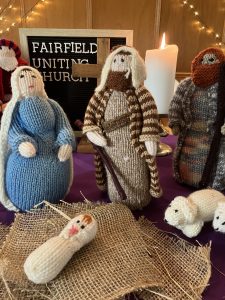
We called this Sunday 28 December “recovery Sunday”. The Sunday snugged between Christmas Day and the New Year on the horizon.
We spent some time in the service sharing with one another, not what we did on the day, but rather, what we thought we were learning or experiencing over the 4 weeks of Advent. Of maybe there was a thought or heart burst that come your way. For me, it was a Christmas where I was so much more clear about the two different Christmas Stories in the Bible: my Advent preparation book, “The Uncluttered Heart” by Beth Robinson was really helpful as a once a week book (other than the every day book it was intended to be): and the heart burst moment was finally seeing Max and paul over at Northcote Plaza on Christmas Eve morning. Max and Paul are Tuesday OpShop friends and they’ve been missing in action for 3 weeks. Turns out Paul was sick in hospital. It was a blessing to see them both.
Our relation on the story of the Holy Innocents was an abrupt change in the joy of the Christmas journey: here are some thoughts:
Matthew is telling a story about Joseph. And Joseph is a dreamer. Are you interested in dreams?
My sister is a woman who pays attention to her dreams: … me, on the other hand, my dreams are more ‘eyes open’ kind of dreams: thoughts while walking or sitting by the river here… And then, for me the dream is less clear or less direct… but that’s how it is for me. What are dreams for you? Is your sense of Spirit holy, informed by dreaming?
The writer of Matthew’s Gospel records all the angelic visits to Jospeh. He’s drawing parallels to the great Hebrew Scripture’s Jospeh (of the Technicolour Dream Coat). And, the writer is emphasising Joseph’s attentiveness, his subsequent decision-making and his actions as a result of that dreaming. We could draw from this a whole lot about our own Spiritual practices and attentiveness and ponder that in our own lives…
The Gospel writer also pulls the attention toward Joseph a– more than the horror of the story about the massacre of the little boys, which compels us with its horror; and also the displacement of the holy family from their homeland. In Matthew’s Gospel we see Joseph’s character, his spiritual practices and how he responds to God.
Kelly Brown Douglas in her book, Stand Your Ground: Black Bodies and the Justice of God, writes on this very reading, against the back drop of deep racism she has experienced in her North American culture.
At the time of Jesus’ birth and we hear the echoes of of the past; dreams if you will … “A voice was heard, weeping and loud lamentation, Rachel weeping for her children, she refused to be comforted, because they are no more.” After discovering the wise people had out smarted his evil intentions, Herod decrees that “all the male children in Bethlehem and in all that region who were two years old and under” be killed. And juxtaposed to this horror: the Gospel writer hears echoes of Rachel’s weeping. Rachel died giving birth to her son Benjamin and she herself was buried in Ramah.
In both Matthew’s Gospel and the prophecy of Jeremiah, Rachel’s weeping is sign: a sign of deep grief and great hope. Her children are gone, and she refuses to be consoled by any justice that the world might offer, particularly as it continues to take her children. She will only be consoled by God.
And so, her weeping, recalled at this, the time of Jesus’ birth, is not simply because Bethlehem is weeping over the loss of its holy innocent children, but because the Christ child is born into our human horror. Into the midst of a mother’s deepest pain and suffering God is present in the world bringing hope. Rachel’s weeping is juxtaposed with the birth of Jesus: as if to say, that there is no power that can stand its ground against God, not even the power of death.
Kelly Brown Douglas goes on to say “It is, thus, through a mother’s weeping that we can see the measure of the hope in the world that is God’s. It is in knowing the deep grief of a mother for her children that we can understand the extent of hope for the justice of God. Feminist and womanist theologians often proclaim God as mother. To know God as mother is for us to see God in the weeping mothers of all African-American mothers who’s children have died at the hand of the police force [Trayvon, Jordan, Jonathan, and Renisha] as they refuse to be consoled until there is justice for their children. (pp. 228-29)
True power is not that of the King Herod’s or any presidents but of the One born in a nothing town, on the edges of Empire, whose parents fled the violence of corrupted power, and who will, only later in his life endure, and in their own lives, will witness, that same violence upon their child.
True power resides precisely on the margins of empire in the compassion and love of a God who suffers with us, not in the corrupted power of all the world’s Herods. The saving Grace of God in Jesus will change the world: but not in the ways of militaristic force or human power: but in the changes of heart in you and me: and in and though us living that grace: and bringing that grace to life in our own living and being.